5 Top Tips for Exhibition Success

This site uses third party services that need your consent.

Categories
In short: a large stand, generally anything over 50 square metres, does not guarantee better results on its own. What it buys is capacity: more conversations at the same time, room for meetings, demonstrations and hospitality, and height that can be seen across the hall. It also brings more rules, more cost and more people to staff. It pays off when every square metre is planned around what the stand has to achieve.
An exhibition stand is a working sales space for three or four days. On a large stand, that space has to do several jobs at once: stop people in the aisle, demonstrate the product, host the meetings that matter, look after existing customers and give the team somewhere to work.
UK brands are putting more money into this. The IPA Bellwether Report has had events as the leading growth category in UK marketing budgets in both quarters reported so far in 2026, with respondents describing more targeted events aimed at commercial outcomes. A large stand is often where those targeted conversations happen.
This guide covers what a large stand is in UK terms, what the extra floor space actually buys, and how to plan and design one so the space earns its cost. We build stands at this scale at ExCeL, the NEC, Olympia and across Europe, so the detail here comes from building them.
There is no formal definition, but most of the industry treats anything over around 50 square metres as large. In the UK that almost always means a space only stand, because shell scheme is rarely sold at that size, and it usually means a peninsula position with three open sides or an island with four.
The position matters as much as the size. An island has no back wall and no neighbours sharing a wall, so every elevation is a front, and sightline rules apply on all four sides. You cannot wall in most of an open side, which is why large stands tend to be built around a central core with open edges rather than as an enclosed box.
Common configurations at this scale include:
Multi-zone layouts: separate areas for attraction, demonstration, meetings and hospitality, each with its own job
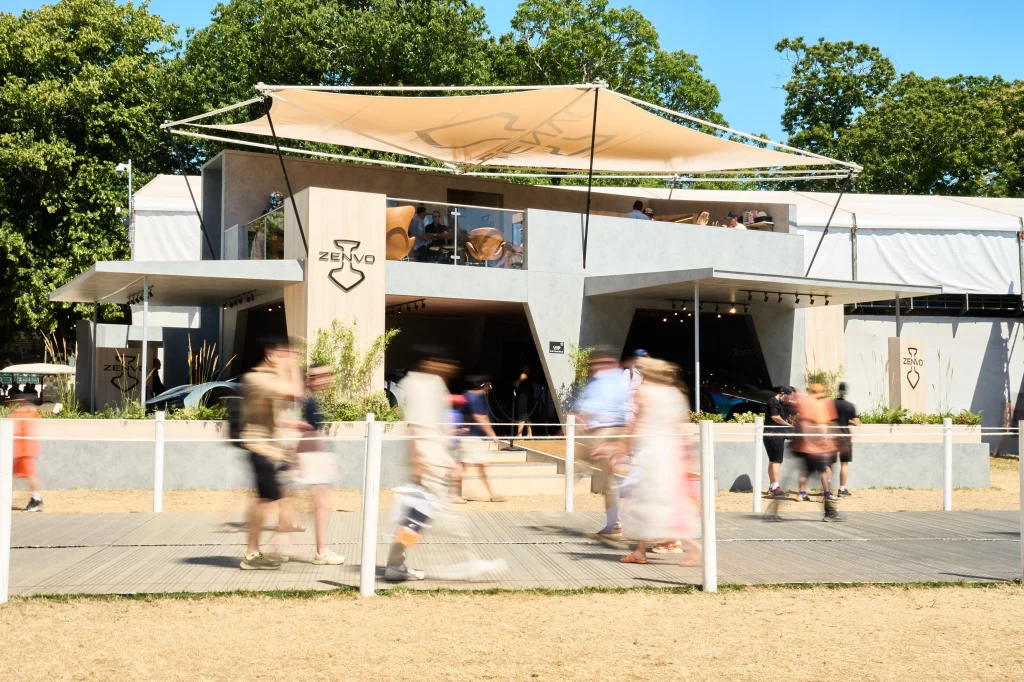
Double-deck structures: a second floor for meetings and hospitality, which needs a show that allows a 6m build height and usually two staircases once the upper deck reaches around 50 square metres, you can see our recent work with Zenvo to get an idea of what this could look like.
Media and interview zones: a quiet, well-lit corner for press, video and content capture
Interactive experience areas: configurators, touchscreens and immersive technology, built into the stand rather than added to it
Presentation stages: a small stage for talks and demonstrations, which brings its own rules on height, guarding and steps
On cost, floor space at a major UK show typically runs £300 to £500 per square metre, so a 50 square metre pitch is around £15,000 to £25,000 before anything is built, and more in a prime position. Our custom exhibition stands range from £25,000 to £500,000 or more, with large stands sitting well above the entry point. Our guide to how much an exhibition stand costs has worked budgets.
Most of the statistics linking stand size to leads come from the US, and many come from companies selling bigger stands. There is little reliable UK data showing that a larger stand produces more business on its own.
What size does change, reliably, is capacity and presence. A larger stand can hold more conversations at once, give them better conditions, and be found from further away. Whether that becomes business depends on the plan, the people and the follow-up.
Scale reads as commitment. A large stand in a strong position tells visitors, competitors and existing customers that you are serious about the market, and that matters most at the shows where your sector gathers once a year.
It also changes how far you are seen. Height lets a stand be found from across the hall, and most major UK venues have galleries or raised catering areas where visitors look down on the floor, so the roof of a large stand is a visible surface too. Anything over 4m is normally a complex structure needing structural calculations. We recently executed one of these builds for Vaillant, please see the case study if you wanted to get a visual idea.
The real argument for size is arithmetic. Every useful conversation needs a person and a place to have it.
Take meetings. A meeting room used for 30-minute meetings across a seven-hour show day can host 14 meetings at most. Over a three-day show that is 42. If the sales target is 100 qualified meetings, you need three rooms or shorter meetings, and that decision shapes the floor plan before anything else does.
Demonstrations work the same way. A ten-minute demo for a group of eight reaches around 48 people an hour at best. If the demo is the main reason people visit, the space for the audience matters as much as the space for the product.
Space alone does not create capacity. A 60 square metre stand staffed by three people has the conversational capacity of a much smaller one and looks emptier. Plan the floor area and the team together, and capture every lead with the context of the conversation, as our guide to measuring exhibition ROI sets out.
Start with the objective, not the layout. Decide what the show is for, what number would prove it worked, and only then what the stand needs to contain. A large stand without a stated objective tends to fill up with features nobody is accountable for.
Different objectives ask different things of the floor area:
Brand awareness: height, an aisle-facing feature and open space, with relatively little enclosed area
Product launch: a reveal or stage area with standing room that does not spill into the gangway
Meetings and lead generation: meeting rooms or semi-private seating, sized to the number of meetings you need. A room for four needs roughly 2.5m by 2.5m once chairs can be pulled out
Product demonstrations: a demonstration zone plus room for the people watching, with a clear view from the aisle
Large equipment displays: heavy exhibits need the hall's floor-loading limits checked, handling booked through the venue's official contractor, and guarding and a risk assessment for anything that moves
Each objective then becomes a design decision.
Meetings mean rooms, and rooms are the most expensive square metres on a stand, because they need doors, lighting, ventilation and sometimes fire detection. They also need to sit back from the open sides because of sightline rules, which is why large stands so often put meeting rooms and storage in a central core.
Demonstrations mean open access and a clear view from the aisle. Sound has to stay within your boundary, with speakers angled towards the centre of the stand, because organisers monitor noise.
Hospitality means planning for services. Under the eGuide, the industry's code of practice, the venue's hospitality caterer holds exclusive rights to food and drink served as hospitality on stands, so your coffee bar or drinks reception is ordered through them rather than your own supplier. A bar also needs water and power ordered from the venue in good time.
Every large stand also needs storage for coats, bags, literature, stock and catering supplies. It is the room everybody forgets until build day.
Size gives you more to work with and more ways to get it wrong. Three principles separate large stands that work from large stands that just look expensive.
A large stand can carry a lot of words. It should not. Pick one message that a visitor can read from the aisle in a couple of seconds and build everything else around it.
On an island this has a particular twist: there is no back. The core message has to work from all four sides, or at least from the two aisles that carry most of the traffic, which you can usually work out from the floorplan and the position of the hall entrances.
Height does the most work. A rigged overhead banner or structure is the classic option, ordered through the venue's official rigging service, usually several weeks before build-up. A ground-supported tower gives height where rigging is impractical, within the complex structure rules above 4m.
Light does the next most. Backlit fabric and LED built into the structure, counters and displays hold up under hall lighting far better than front-lit print, and they reuse well from show to show.
Because an island has no neighbours sharing a wall, every elevation can carry branding. On a peninsula, the back wall usually adjoins a neighbouring stand, and above 2.5m that reverse face has to be finished in a neutral colour without branding.
Zoning turns a large footprint into a sequence. A typical large stand works from the outside in: something at the edges that stops people, a demonstration or product area in the middle, and meetings, hospitality and storage at the core or upstairs.
The rule is that visitors should never have to walk through one zone to reach another. Nobody wants to cross a client meeting to get to a demo, and nobody in a serious conversation wants a crowd forming behind them. The drinks bar on our MSC stand at the NEC and the seating and drinks counter on Agrovision's stand at Messe Berlin are both examples of hospitality given its own space rather than squeezed between displays.
A large stand is easier to find but not automatically easier to walk onto. Visitors decide in seconds whether a stand is for them, and an imposing build can feel as though it is only for people with an appointment.
Pre-show outreach: book meetings before the show. On a large stand, the meeting rooms should be largely booked before the doors open, with time held back for walk-ups
Personalised invitations: many organisers give exhibitors invitation codes or links for free visitor registration. Sent personally to named contacts, they bring in the people you actually want
Social media: post from the stand during the show, especially demo times and speaker slots, so people already in the hall know when to come over
Augmented reality installations: a 2026 study in Scientific Reports found AR and VR exhibits at three trade fairs drew 30% to 80% more visitors than the fairs' average per exhibitor. Plan for throughput, because one headset serves one person at a time
Staff placement: most visitors arrive from the main aisles, so put your most approachable people on the busiest edges rather than behind a counter in the middle
A large stand gives you capacity, presence and room to do several things well at once. It does not do the selling. The stands that justify their size are planned from the objective outwards: how many meetings, how many demos, which visitors, and what the space has to look like from the furthest aisle.
The cost is real, in floor space, build, venue services and staff. A reusable structure brings the cost per show down sharply if you exhibit at this scale more than once, and our modular exhibition stands and custom builds are designed with that in mind.
We design, print, build, install and store in-house, from shell scheme to double-deck. Every project starts with a free 3D design concept, and we quote to your brief rather than a price list. Look through the portfolio, or talk to us about your next large stand.
Last updated: [DATE]. Stand rules, venue services and catering arrangements vary by show and venue. Always work from the current exhibitor manual for your event.
How much does a large exhibition stand cost in the UK? For a 50 square metre stand at a major UK show, floor space alone typically costs £15,000 to £25,000, and more in a prime position. The build is billed separately: our custom stands range from £15,000 to £500,000 or more, and the large stand we built for Agrovision at Messe Berlin sat in our £50,000 to £75,000 bracket. Venue services usually add 15% to 30%.
Is a larger stand always the right choice? No. A larger stand only helps if you can fill it with the right people and the right activity. A 60 square metre stand staffed by three people looks emptier and holds fewer conversations than a well-run smaller one. A strong corner or peninsula position, a clear message and enough trained staff often do more than extra floor area.
How quickly does a reusable large stand pay for itself? Usually by the second show. A reusable structure costs more to build the first time, but later outings cost mainly transport, installation and refreshed graphics, plus storage between shows. It works best when the stand is designed to reconfigure across the pitch sizes you actually book, so the same core can go to a 50 square metre island one month and a smaller peninsula the next.
Who actually visits large exhibition stands? The same visitors as every other stand, but a large stand serves part of that audience better: buyers who want a proper meeting, existing customers, partners, press and senior decision-makers. UK exhibitions drew almost 6.8 million visits in 2025. To see who attends a specific show, ask the organiser for its ABC-audited attendance certificate and look at the visitor figure, which excludes exhibitor staff.
How does stand size affect brand awareness beyond direct leads? A large stand is seen by far more people than walk onto it: from across the hall, from galleries and on the walk between halls. That reach is real but hard to measure directly. The practical measures are branded search and website traffic during show week compared with a normal week, social mentions, press coverage, and a short post-show recall survey of your target list.
Categories
Related insights